
I’m the creator of lightGallery, an open-source JavaScript gallery library I’ve been maintaining since 2013. It’s free under GPLv3 and makes its money through commercial licenses. For years that business just ran on one channel: Google. Developers searched for things like “javascript gallery” or “react image gallery”, found my site ranking in the top 3, tried the demos, and some of them bought licenses.
Last year revenue started dropping. Then it kept dropping. I didn’t really dig into it, because this isn’t my main product and I barely get time for it. Most of my time goes into Kelviq, the Merchant of Record and payment platform we’re building for AI and SaaS companies.
And I didn’t push on it either, because the traffic graph looked fine. Down maybe 10%, which I lazily put down to AI. I figured people just needed the library less now, that they were asking Claude Code or Codex to generate a minimal version instead of reaching for a dependency.
Turns out that was wrong. The site was quietly bleeding the only traffic that actually mattered, and the graph was hiding it. So here’s the whole breakdown, numbers and all, because I think a lot of product sites are making the same mistake I made.
How I accidentally found it
I’ll be honest about how this even started. I had Fable credits about to expire and didn’t want to waste them, So I exported my Google Search Console and Analytics data, handed everything over, and asked it do a full SEO audit.
(Funny detail: I ran the first analysis on Opus 4.8 by mistake, thinking it was Fable. Opus didn’t catch any of this.)
The first thing it did was refuse to look at total traffic. It split my queries into three buckets instead: brand searches, developer-intent searches, and searches for the free tools I’d bolted onto the site. That one move changed everything, because the traffic that looked fine was really two opposite stories cancelling each other out.
What the data actually showed
Here’s what the data showed. Last 3 months against the same period a year earlier:
| Segment | Clicks (last year) | Clicks (now) | Change |
|---|---|---|---|
| Brand searches (“lightgallery”, “lightgallery react”…) | 6,016 | 2,873 | -52% |
| Developer searches (“react image gallery”, “lightbox js”…) | 7,759 | 3,875 | -50% |
| Free-tool searches (“youtube thumbnail download”…) | 2,221 | 9,562 | +330% |
Total traffic was down 12%. The traffic that actually converts, down by half.
A while back I’d added a few free tools to the site. A YouTube thumbnail downloader. A JavaScript library usage tracker, with a page for every popular library. A jQuery-to-JavaScript converter. The idea was to pull developers in, and honestly some of them were fun to build.
The thumbnail downloader blew up in search. By this year it was doing 1.4 million impressions on a single query and had quietly become 47% of all my clicks. But nobody typing “youtube thumbnail download” is a developer shopping for a gallery library. They were never going to buy a commercial license. Not one of them ever did.
The geography and device data said the same thing. My buyers are developers on desktops in the US and Europe, and that whole segment was collapsing: desktop clicks down 41%, the US down 34%, Germany down 41%, the UK down 41%. Meanwhile mobile traffic from thumbnail-download searches tripled. Most of the new traffic was no longer coming from potential buyers.
How Google re-learned what my site was about
Here’s the mechanism, as plainly as I can put it.
Google doesn’t rank pages in isolation anymore. It builds up a sense of what a site is about, its topical authority, and that sense bleeds into every page. For a decade, lightgalleryjs.com meant “JavaScript gallery library” to Google, and My demo pages ranked top 3 for competitive terms on that authority.
Then the free tools started outgrowing the actual product. And it wasn’t only the traffic:
- The thumbnail tool became the majority of my clicks and impressions.
- It started dragging in low-quality backlinks. When I looked at my latest links, a good chunk were junk: scraper sites, pirated-content pages, even a couple of gambling domains. Not the dev blogs that used to link to me.
- The library tracker had grown into 90 nearly identical low quality pages that made up more than half my indexed pages and earned maybe 1% of the clicks.
So traffic, links and indexed pages were all telling Google the same new story. And when the February 2026 core update landed, the kind that rewards topical authority and punishes thin content, Google re-graded my site on that story. In its eyes lightGallery had turned into a thumbnail-downloader site with some JS demos attached.
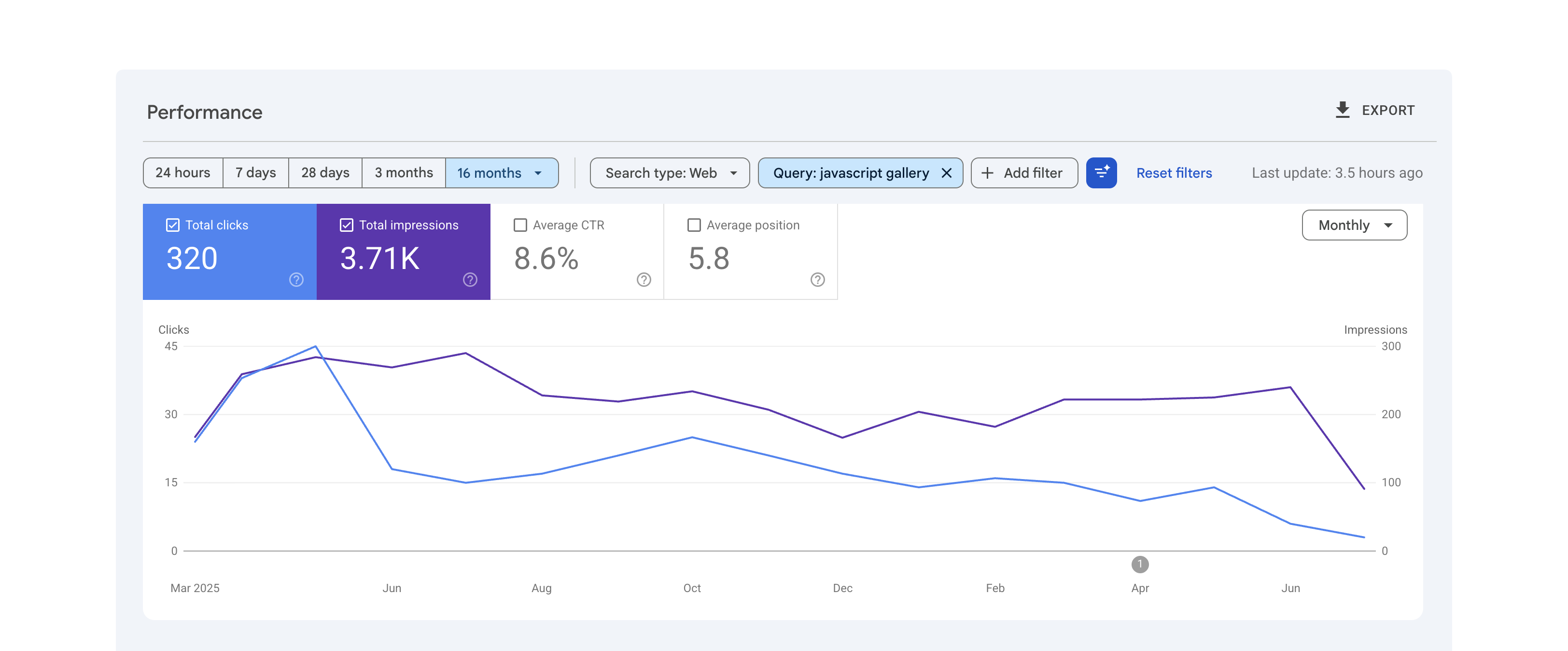
The keywords that actually mattered, the ones that had ranked top 3 for years, got demoted one by one. “javascript gallery” fell from position 2 to 15. “react image gallery” from 2.5 to 6.7. Even my own brand name slipped, 1.2 to 2.2.
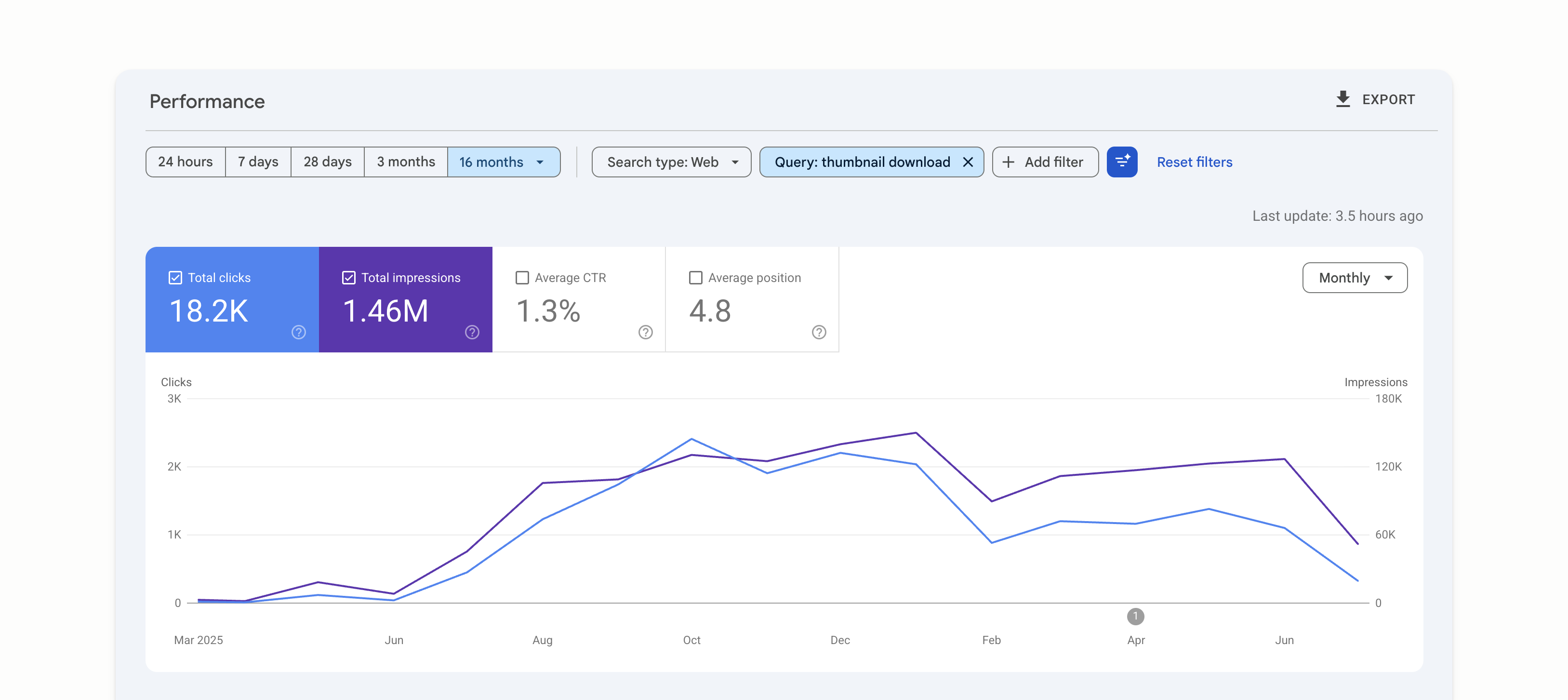
And the keywords that was not adding any value to site blew up.
That crossover is the whole story. The exact stretch where the free tools took off is the exact stretch where the keywords that mattered started sliding. And when I looked closer it wasn’t even one problem. It was three, stacked on top of each other.
Three problems hiding under one graph
Once I lined the decline up against real dates, it stopped looking like a single event. Three different things had happened, and they piled up:
June 2025, AI Overviews took the informational clicks. Impressions stayed flat, clicks fell by half. I hadn’t lost rankings, people had just stopped clicking, because Google’s AI box now answers “how do I build an image gallery” right there on the results page. So yeah. You can sit at #1 and still lose the traffic.
February and May 2026, core updates demoted the diluted site. This is when the actual drops happened. Core updates are when Google re-decides what your site is about.. and by then, the free tools had already changed the answer.
And the whole time: Junk traffic was hiding everything. This is the part that still annoys me. If the thumbnail tool didn’t exist, my traffic graph would have shown a clear 50% collapse and I would have started digging a year earlier. Instead the graph said “down 10%, nothing to worry about.”
Thats the thing about an average. It doesn’t just hide the problem, it delays the day you even go looking for it.
What I’m doing about it
The fix list, roughly in the order I’m shipping it:
- Deleting the thumbnail downloader. Yes, I’m removing the page that brings in 47% of my traffic, on purpose. It costs real money to run, brings zero customers, pulls in spam links and poisons my topical authority. Removing it will reduce traffic significantly, but it should improve the quality of the site over time.
- Pruning the thin pages. Of the 90 tracker pages, nine earn almost all the clicks. Those stay and get real content. The rest go.
- Keeping the jQuery converter. This one’s the counter-example that proves the rule. Same site, but its audience is developers (my buyers), and it earned 180+ genuine dev backlinks. Relevant free tools are still great marketing, that was never the problem.
- Fixing the boring stuff the audit turned up: mobile Core Web Vitals failing on all 65 pages, a few schema bugs, and an analytics tag that, embarrassingly, had been dead since Google killed Universal Analytics back in 2023.
- Doubling down on what actually grew. When I segmented things, one type of content was quietly up double digits while everything else fell. The pattern is the useful part: AI answers the “how to” questions now, so the clicks that survive are the ones where someone is deciding between options, not learning a concept. That’s where the content effort goes next.
- Treating AI as a channel, not just a threat. ChatGPT is already my #3 traffic source, 12,000+ sessions with engagement about level with my Google visitors. Developers ask it “what lightbox should I use for React” and click through. So the site’s getting an llms.txt, cleaner structured data, and docs an LLM can actually cite.
What I’d tell you to check today
If you take five things away from my mistake, take these:
- The person searching for your tool has to be someone who’d actually buy the product. That’s the whole test. Ask “would a person typing this query ever pay me?” If the answer is no, that traffic isn’t just dead weight, its actively costing you money.
- Segment your data or it will lie to you. Open Search Console, strip out the off-topic queries, and look hard at what’s left. My total said down 10%. The slice that pays my bills said down 50%. Same graph, two completely different stories.
- Traffic is not the asset. Topical authority is. It takes years to build and one viral side page to dilute.
- If you really want off-niche tools, keep them off your main site. A separate domain or subdomain is cheap insurance against Google re-reading everything you own.
- Watch your money pages, not just your traffic. The scariest number in the whole thing wasn’t a big one, it was a tiny one: “lightgallery license key” went from 51 clicks to zero impressions. People trying to hand me money, walking straight into a wall, silently.
Dos and don’ts for building free tools for SEO
Free tools are still great marketing for a product.. mine just taught me they come with rules. Here are the dos and don’ts based on my experience:
Do:
- Build mini versions of your own product. The safest free tool is a small piece of the thing you actually sell, with a path to the full version. The person searching for it and the person who’d buy from you are the same person.
- Run the buyer test before writing any code. Search the queries your tool would rank for.. see who’s searching them and what else is ranking. If the results are full of consumer and spam sites, that’s the audience you’re about to invite in.
- Add a bridge on every tool page. A clear next step to your product.. not a random banner, but a genuine “if you’re doing X, our product does the full version” path. And track it as a conversion.
- Set a traffic limit upfront. Something like: “if this tool ever crosses 20-30% of my site’s clicks, I move it to a subdomain.” Write it down somewhere. Viral growth feels like winning.. right until Google re-reads your site.
- Check the tool’s backlinks every few months. Search Console → Links → latest links. If the tool is pulling in scrapers, gambling sites, and random IP-address domains.. that neighborhood slowly becomes part of your site’s identity.
- Keep tools few and deep, not many and thin. One really good tool earns links. Twenty shallow ones earn “crawled, currently not indexed”.
Don’t:
- Don’t chase volume outside your niche. “youtube thumbnail download” had millions of impressions. That’s exactly why I built for it.. and exactly why it hurt me. Volume you can’t convert isn’t free traffic, it’s dilution.
- Don’t generate a page for every keyword variant. My library tracker became 90 near-identical pages earning 1% of my clicks.. more than half my indexed pages telling Google my site was something it wasn’t. If one page can answer it, build one page.
- Don’t judge a tool by its traffic graph. Judge it by customers.. or at least by signups or product-page clicks it produces. A tool with 10x the traffic and zero conversions isn’t an asset, it’s a liability that looks good in screenshots.
- Don’t put big off-niche experiments on your main domain. If you really want to build the fun viral thing, give it its own domain. It can always link back to you.. it can’t dilute you from there.
- Don’t forget the running costs. I was paying real server bills every month to serve users who would never buy anything.. while the same tool was pulling down the rankings that actually make money.
- Don’t wait for a core update to learn what Google thinks your site is about. Once a quarter, look at your top queries by impressions and ask one question: does this list describe my product? The day it doesn’t, you’re already in trouble.
Where should the tool live? Main domain vs subdomain vs separate domain
This is the one I got properly wrong, so let me save you the deliberation. There are three options, and each is a different trade between how fast it ranks and how much damage it can do.
On your main domain (yoursite.com/tool/), which is what I did.
- Pros: the tool inherits your full domain authority, so it ranks fast. Mine went from nothing to millions of impressions in a few months. Every link it earns feeds your whole site, there’s basically no setup, and visitors are one click from your product.
- Cons: everything is shared, and that’s exactly the risk. The tool’s traffic mix, its link neighbourhood, its page quality, all of it feeds Google’s read of your site. If the tool is off-niche and outgrows the product, it becomes your site’s identity and nothing stops it. Pulling it later means visibly torching half your traffic graph.
- Use it when the tool sits dead center in your niche and its searchers are your buyers. My jQuery converter lived here for years without a scratch: right audience, real backlinks, no dilution.
On a subdomain (tools.yoursite.com).
- Pros: a real firewall. Google mostly treats subdomains as their own site, so the tool’s topical signals, thin pages and junk links largely stay on their side of the fence. You keep the brand, the shared infra and the easy cross-linking, and if the tool blows up your main domain stays intact.
- Cons: “mostly” is doing a lot of work in that sentence. The separation is real but not absolute, and Google has flip-flopped over the years on how independently it treats subdomains. The tool also starts with only partial authority, so it ranks slower, the links it earns help your product less, and you’ve now got two properties to verify and babysit in Search Console.
- Use it when the tool is adjacent to your niche. Close enough to share a brand, not close enough to bet your rankings on. It’s also the right retirement home for a main-domain tool that outgrew your comfort level.
On a separate domain (sometool.com), you get total insulation. The tool can go as viral as it likes, attract whatever link neighbourhood it attracts, and your product site never feels a thing. You can monetise it on its own, redesign it whenever you want, even sell it off one day. The catch is you’re starting from zero: no authority, no rankings, and maybe months or years before it competes for anything real. None of its links or traffic help your product directly either, cross-promotion is just an ad on someone else’s site, even when that someone is you. Honestly, my thumbnail downloader should have been born here. It would have grown just as well (high-volume, low-competition queries don’t need much authority) and my gallery keywords would still be sitting top 3.
So, the short version: relevance decides the address. If your buyers are the ones searching, main domain. A neighbour of your niche, subdomain. Total strangers, separate domain. And when you genuinely can’t decide, pick the more isolated option. Placing a tool too far out only costs you a little ranking speed. Placing it too close can cost you the rankings you already have.
The bigger lesson about leaks
The thing that actually stays with me isn’t the SEO mechanics. It’s that this leak stayed invisible for a year because the data I was looking at was aggregated. Revenue fell, the top-line graph shrugged, and every month I didn’t segment was another month the problem quietly compounded.
That’s true for traffic, and it’s every bit as true for pricing and billing. Averages hide who’s really paying you, who’s slowly churning, and which segment is quietly subsidising which. It’s a big part of why we’re building Kelviq: so revenue data comes pre-segmented, and a leak like this shows up in week one instead of year two.
So if your revenue is drifting down while the dashboards look fine, go segment something today. The hole is usually right there, hiding inside an average.